News
“Quantum technology will be part of our everyday lives in ten years”
D-PHYS

In part two of the interview marking the 100th anniversary of quantum mechanics, ETH Professor Klaus Ensslin explains why quantum technology is developing at such a rapid pace at the moment and why Switzerland needs to make an effort if it doesn’t want to be left behind.
“Quantum mechanics upended our thinking”
D-PHYS

Three quantum researchers were presented with the Nobel Prize in Stockholm on 10 December. Meanwhile, this year marked the centenary of quantum mechanics as a field of research. In this two-part interview, ETH Professor Klaus Ensslin looks back at its beginnings and talks about where the technology is headed.
Farewell after three decades of light and leadership at ETH Zurich
- D-ITET
- D-PHYS

Ursula Keller, Professor of Physics at ETH Zurich, will deliver her farewell lecture on Monday, 15 December 2025. Her talk, entitled “Ultrafast science: a 32-year journey in Physics at ETH Zurich,” marks the close of more than three decades at the forefront of ultrafast laser science – a field she helped build from the ground up.
Cosmological tension confirmed

An international collaboration released new constraints on the value of the Hubble constant based on the study of strongly lensed quasars.
Eleven professors appointed
- D-BSSE
- D-HEST
- D-MATH
- D-GESS
- D-EAPS
- D-INFK
- D-CHAB
- D-BIOL
- D-USYS
- D-ITET
- D-ARCH
- D-MAVT
- D-PHYS

At its meeting of 3 and 4 December 2025 and upon application of Joël Mesot, President of ETH Zurich, the ETH Board appointed eleven professors. In addition, seven adjunct professorships were awarded.
What's at stake in high-energy particle physics

As particle physicists envision the future of their discipline, one point is clear: there's much potential for exploration and discovery beyond the Standard Model.
Golden Owl to Sascha Quanz

Sascha Quanz was awarded the Golden Owl for his teaching activities in the Department of Physics. Every year, the ETH Zurich Student Association (VSETH) honours lecturers whose excellent teaching stands out with this award.
Exoplanets are not water worlds
- D-EAPS
- D-PHYS

There is much less water on the surfaces of distant planets outside our solar system than previously thought. These exoplanets do not have thick layers of water, as was often speculated. That’s the conclusion of an international study led by ETH Zurich.
ERC Starting Grants: success for ETH researchers
- D-USYS
- D-EAPS
- D-MATL
- D-INFK
- D-MAVT
- D-PHYS

Nine researchers from ETH Zurich have just been awarded Starting Grants from the European Research Council (ERC). This is a positive signal for Zurich as a research location.
Eight professors appointed
- D-HEST
- D-MATH
- D-BAUG
- D-EAPS
- D-ITET
- D-INFK
- D-ARCH
- D-BIOL
- D-PHYS

At its meeting of 9 and 10 July 2025 and upon application of Joël Mesot, President of ETH Zurich, the ETH Board appointed eight professors. The Board also awarded the title of "Professor of Practice" once.
Elaborate search for a new force
D-PHYS

Scientists are using trapped ions in experiments to search for signs of a new particle that could help explain the mysterious dark matter. Researchers at ETH Zurich are combining their results with findings from teams in Germany and Australia.
Back in the running with ERC grants
- D-HEST
- D-BSSE
- D-BIOL
- D-PHYS

Two biologists, an engineer, a physicist and a health scientist from ETH Zurich have been awarded ERC Advanced Grants worth around 12 million euros. The researchers are among the first in Switzerland to receive this prestigious EU research funding after a hiatus of several years.
Innovation needs freedom
- D-ITET
- D-PHYS

ETH alumni Moritz Lechner and Felix Mayer have founded Sensirion, an internationally successful company. Now the two physicists look back. What has remained of their education at one of the best universities in the world?
A degree for the quantum age
- D-ITET
- D-PHYS

In 2019, ETH Zurich launched one of the world’s first Master’s degrees in Quantum Engineering. Since then, interest in the programme has soared – and its first graduates are already making their mark in industry.
Ultra-thin lenses that make infrared light visible
D-PHYS

Physicists at ETH Zurich have developed a lens with magic properties. Ultra-thin, it can transform infrared light into visible light by halving the wavelength of incident light.
Happy Birthday, ESA!
- D-USYS
- D-PHYS
- D-EAPS

The European Space Agency (ESA) is celebrating its 50th anniversary. ESA has helped make Europe more technologically independent and has played a key role in space exploration in recent decades. And ETH Zurich has always been one of its partners on its journey.
Six professors appointed
- D-MTEC
- D-MATH
- D-HEST
- D-EAPS
- D-CHAB
- D-BIOL
- D-USYS
- D-BAUG
- D-ITET
- D-ARCH
- D-MAVT
- D-PHYS

At the meeting on 21st and 22nd May 2025, the ETH Board appointed two female and four male professors at the request of ETH President Joël Mesot. The Board also awarded the title of "Professor" three times and the title of "Professor of Practice" twice.
To search for new physics, cast a wide net to sieve through particle data
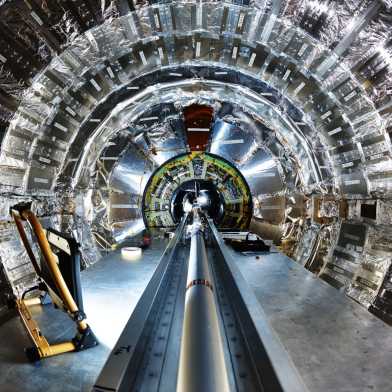
Thea Klaeboe Aarrestad talks about her research at CERN and retraces how she became interested in the power of machine learning methods for particle physics.
Ten years of gravitational-wave detections
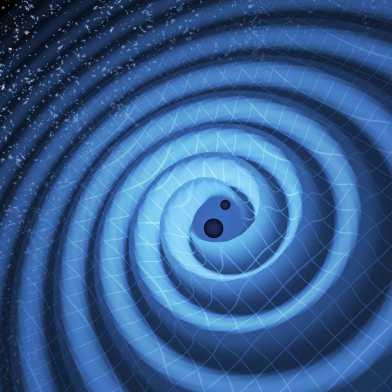
We spoke with Michele Vallisneri about his recent move to ETH Zurich, his research plans and the profound impact of the first gravitational-wave detection in 2015.
What if we don’t find any life on the exoplanets, Doctor Angerhausen?
D-PHYS

The planned space missions to search for remote life will provide valuable insights even if they do not find any evidence of life, says astrophysicist Daniel Angerhausen.
Higgs, hadrons, big ideas: CERN experiments receive Breakthrough Prize
D-PHYS
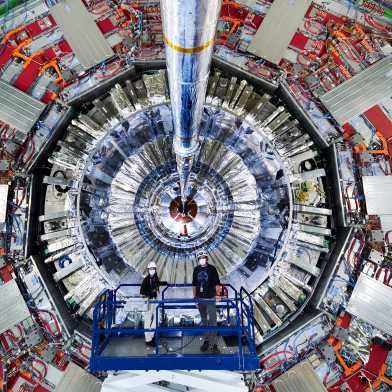
At a ceremony in Los Angeles on 5 April, the four major experimental collaborations at CERN’s Large Hadron Collider (LHC) – ALICE, ATLAS, CMS and LHCb – were awarded the prestigious Breakthrough Prize in Fundamental Physics.
In the search for life on exoplanets, finding nothing is something too
A team led by researchers at ETH Zurich's Institute for Particle Physics and Astrophysics studied what insights can be gained from a 'no life detected' scenario in future exoplanet surveys.
Elementary-particle detectors, 3D printed
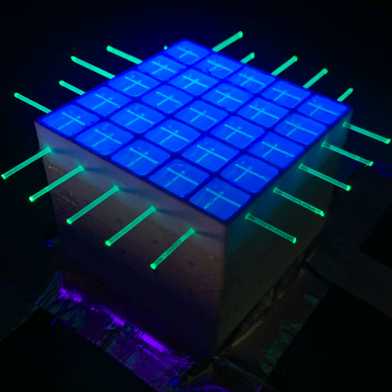
An international collaboration headed by researchers in the Department of Physics has shown that additive manufacturing offers a realistic way to build large-scale plastic scintillator detectors for particle physics experiments.
Crystal lattice at a distance
D-PHYS

Researchers at ETH Zurich have developed a method that makes it easier to study interactions between electrons in a material. Using a moiré material consisting of twisted atomic layers they created an artificial crystal lattice in a neighbouring material.
Four SNSF Advanced Grants go to ETH Zurich researchers
- D-BIOL
- D-ITET
- D-MATL
- D-PHYS
A biologist, a neuroscientist, a materials scientist and a physicist have each been awarded one of the prestigious grants of the Swiss National Science Foundation.
Good news for gamma-ray astronomy
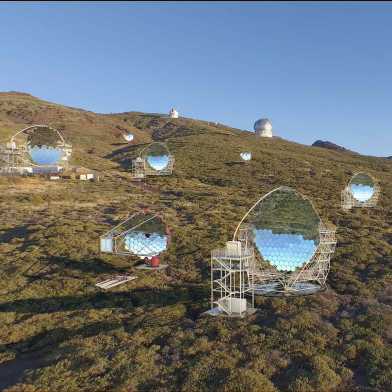
The latest development on the Cherenkov Telescope Array Observatory brings a step closer the prospect of new insights into some of the most energetic phenomena in the Universe.
Eight SNSF Starting Grants for ETH researchers
- D-USYS
- D-MATH
- D-HEST
- D-BAUG
- D-PHYS
Four women and four men successfully applied for Starting Grants from the Swiss National Science Foundation via ETH Zurich.
Measuring cosmic distances to understand the expanding universe
D-PHYS
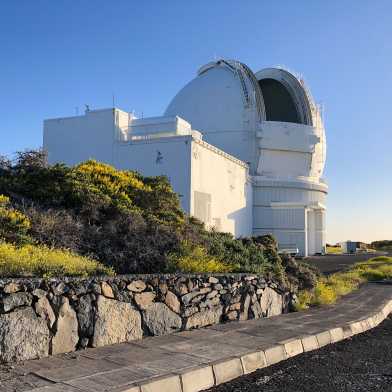
The group of Professor Alexandre Refregier uses the data collected by ambitious surveys to work out the nature of dark matter, dark energy and our expanding universe.
Between crystals, cats and quantum
D-PHYS
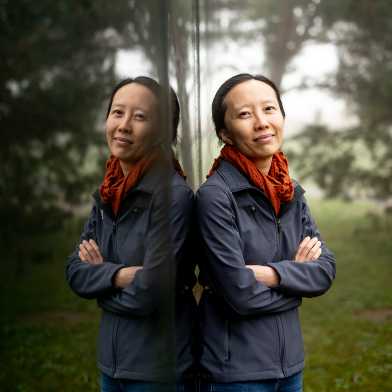
ETH Professor Yiwen Chu is investigating how to apply quantum states to ever larger objects. This should help to gain new insights into physics and develop more efficient technologies. She has now been awarded the ETH Zurich Latsis Prize for her outstanding research.
Record-breaking laser pulses
- D-ITET
- D-PHYS
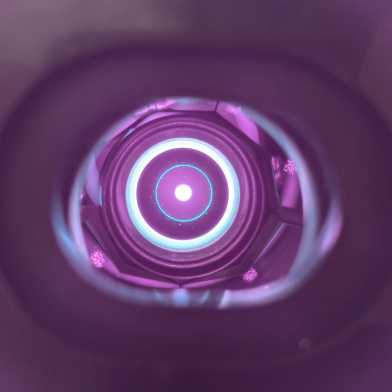
Researchers at ETH Zurich have developed a laser that produces the strongest ultra-short laser pulses to date. In the future, such high power pulses could be used for precision measurements or materials processing.
Fifteen professors appointed
- D-BSSE
- D-HEST
- D-GESS
- D-INFK
- D-CHAB
- D-BIOL
- D-USYS
- D-BAUG
- D-ITET
- D-ARCH
- D-PHYS
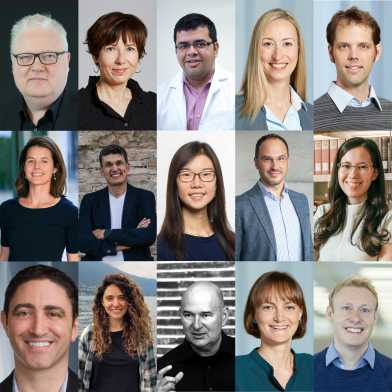
At its meeting of 18 and 19 September 2024 and upon application of Joël Mesot, President of ETH Zurich, the ETH Board appointed fifteen professors. The Board also awarded the title of "Professor of Practice" once.
Planets contain more water than thought
D-PHYS
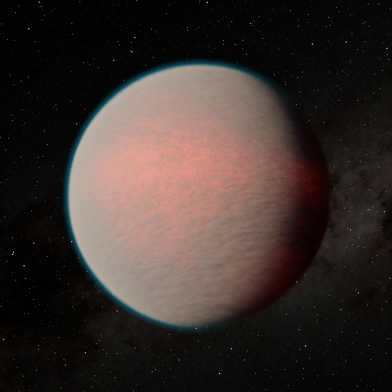
Most of a planet’s water is generally not on its surface but hidden deep in its interior. This affects the potential habitability of distant worlds, as shown by model calculations of researchers at ETH Zurich and Princeton University.
Six professors appointed
- D-USYS
- D-MTEC
- D-BSSE
- D-MATH
- D-HEST
- D-BAUG
- D-CHAB
- D-PHYS
At its meeting of 11 and 12 July 2024 and upon application of Joël Mesot, President of ETH Zurich, the ETH Board appointed six professors. The Board also awarded the title of "Professor" two times and the title of "Professor of Practice" once.
When greenhouse gases are useful
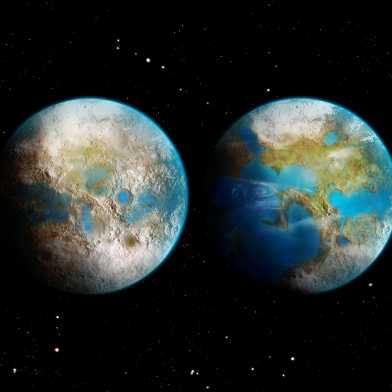
Researchers showed that current and planned instrumentation can detect technosignatures in the form of artificial greenhouse gases in exoplanetary atmospheres.
Final design of ELT's METIS instrument completed
D-PHYS
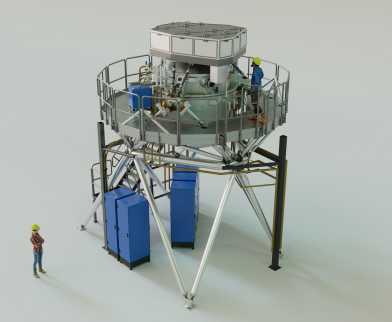
METIS is the first instrument of the Extremely Large Telescope to pass its final design review.
Electron vortices in graphene detected
D-PHYS
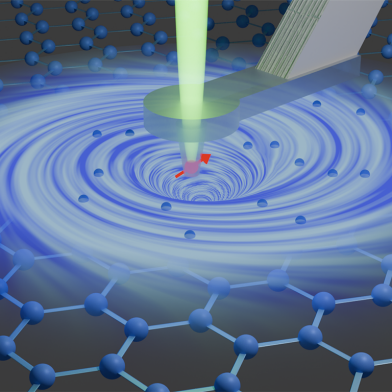
Researchers at ETH Zurich have, for the first time, made visible how electrons form vortices in a material at room temperature. Their experiment used a quantum sensing microscope with an extremely high resolution.
Solving physics puzzles with coloured dots
D-PHYS
By analysing images made of coloured dots created by quantum simulators, ETH researchers have studied a special kind of magnetism. In the future this method could also be used to solve other physics puzzles, for instance in superconductivity.
Surprising reversal in quantum systems
D-PHYS
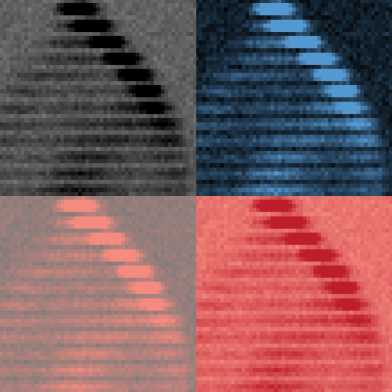
Researchers at ETH Zurich have studied topological effects in an artificial solid, making surprising observations. The new insights into topological pumping could be used for quantum technologies in the future.
A new ion trap for larger quantum computers
D-PHYS
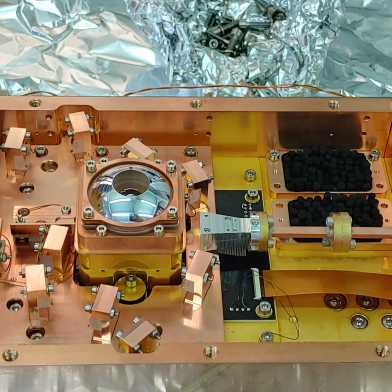
Researchers at ETH have managed to trap ions using static electric and magnetic fields and to perform quantum operations on them. In the future such traps could be used to realize quantum computers with far more quantum bits than have been possible up to now.
Triathlon medallist and ETH student: “A non-productive day is not the end of the world.”
D-PHYS

Studying at ETH Zurich is demanding, and all students have their own personal hurdles to overcome. This video series portrays ETH students.